By Bill Huston, WilDar Golf Carts & Trailers
Most people think there’s a safety net under a vehicle purchase. The brand might disappear, but somebody has to supply parts for ten years. Somebody has to honor the golf cart warranty. The government makes them. I believed that in the truck business, and I was wrong. Here’s what the law actually gives you — and who it gives it against.
Not certified? You have nothing.
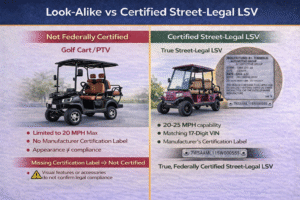
Let me say this first, because everything after it depends on it. A golf cart or LSV with no federal certification label has no protection beyond ordinary civil law. You can sue whoever sold it to you. That’s the list. There is no manufacturer on file, no recall duty, no federal remedy of any kind, because legally nobody built the vehicle. Every protection described below exists only for a certified vehicle, and every one of them is owed by the company whose name is on that label.
The ten-year golf cart warranty law
There isn’t one. No law, federal or Florida, makes any vehicle manufacturer supply parts for any number of years. Not ten, not one.
What does exist is a recall law. If a certified vehicle has a safety defect, or fails a federal safety standard, the manufacturer has to fix it for free — for eight years when that rule was written in 1974, ten years after 2000, and fifteen years since 2015. That’s where the “ten-year law” came from. It covers recalls. It doesn’t cover a wiper motor or a controller or a seat.
Two more things that law says. The “manufacturer” of an imported vehicle is the importer — the company whose name is on the certification label, not the factory overseas. And since 2012, bankruptcy doesn’t erase the recall duty; it becomes a government claim ahead of other creditors. On paper, that’s the strongest protection you have.
Every right points at a name
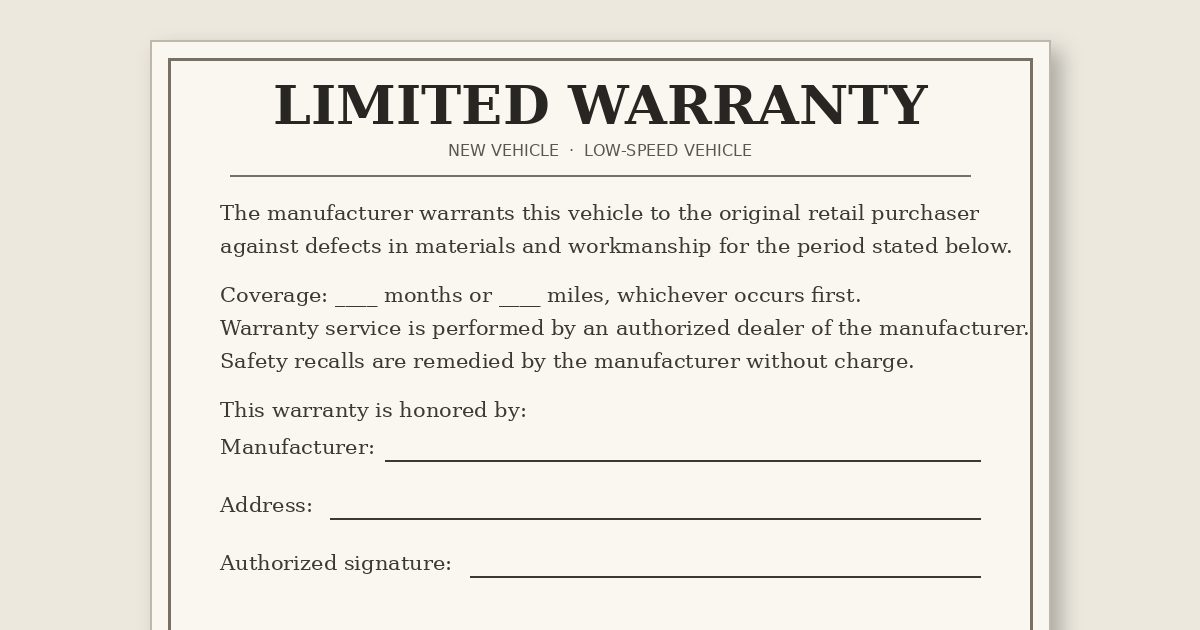
The recall duty belongs to the company that certified the vehicle — the one on the label below the dash, registered with the federal decoder, with a U.S. agent on file if it’s foreign. The warranty is good against whoever signed it, for exactly as long as it says. That label isn’t a formality that gets a cart registered. It’s the document that says who owes you the fix. That’s why the last article had you go find it.
What it looks like at our size
Forget Pontiac. The companies that match a Florida showroom are smaller, and the story is the same every time.
Miles Electric Vehicles sold the first Chinese-built street-legal vehicle in this country, a low-speed vehicle certified to the same standard as the carts on our lot. It went bankrupt in June 2013. Owners were left without dealers, support or parts; fleets stripped some vehicles to keep others going. Its spin-off, Coda, folded a month earlier after fewer than 120 cars.
ZAP sold the Chinese-built Xebra, fewer than 1,500 of them. It failed federal brake tests in 2008. In 2012 the government ordered a buyback; in 2013 it sued, calling ZAP’s recall notices “false, misleading, untimely, or non-existent.” The recall was filed by the Chinese factory through ZAP as its agent. Owners got their letters 429 days later. Parts come from one old dealer’s leftovers, not from the Chinese factory.
The scooter importers from the last article: warranties disclaimed by the factory’s own U.S. arm, while the factory came back under a new name and VIN code. VanMoof in 2023. Cushman’s sixty dealers in 1975.
One from the other end. When GM retired Oldsmobile, used values dropped 5 to 10 percent. GM honored the warranties and GM dealers kept fixing the cars. That’s what insulation looks like — and it’s there because a parent company with dealers stayed.
What isn’t protected
Parts after the warranty. Service. Resale value. And all of the above the day the importer on the label is gone and the factory is overseas. The factory isn’t the “manufacturer” unless its name is on the label, and the government reaches a foreign factory through the U.S. agent it named. No agent, no reach. Florida doesn’t fill the gap: a dealer’s bond covers the dealer’s own violations, not the brand it sold.
My Take
I don’t know which brands will be here in five years. I do know where to look. The law gives you a recall repair and a warranty, and both are owed by the company on the certification label. If that’s a U.S. business with its own name on the label, assets here, and dealers who’d notice if it vanished, you’ve got what the law intended. If it’s a name you can’t find — or there’s no label — you’ve got the vehicle and nothing else. That isn’t a prediction about anybody. It’s the shape of the protection, and it was the same shape for Miles, ZAP and Coda.
Check your own paper
Two names. The first line on your certification label is the manufacturer. Look that company up — not the brand — at vpic.nhtsa.dot.gov under manufacturer information. Then take the dealer license number off your buyer’s order and run it through the state’s dealer license search. If both come back, you know who owes you what. If there’s no label, you know what that means too.
More in this series: Automotive History: Every New Industry Buries Most of Its Brands · Gray-Market Vehicles: The Discount Today, the Cost Tomorrow · What’s My Golf Cart Worth? How Trade-In Value Is Figured · Golf Cart Warranty: Parts and Labor, or Just Parts?
The brand tiers are on the Best Golf Cart Brands 2026 page. What the label says, line by line, is on our FMVSS 500 page.
Sources: 49 U.S.C. 30102, 30120(g) and 30120A; Pub. L. 93-492 (1974); TREAD Act (2000); FAST Act (2015); Magnuson-Moss Warranty Act; 49 CFR Parts 551, 566, 567; Fla. Stat. 320.27(10); Kelley Blue Book via CNN Money, Dec. 29, 2009; Reuters, June 2013 (Miles); NBC News, May 2013 (Coda); Press Democrat 2012–13 and NHTSA recall 12V-230 (ZAP); Golfdom, Aug. 1975; Reuters/NPR 2023 (VanMoof).