
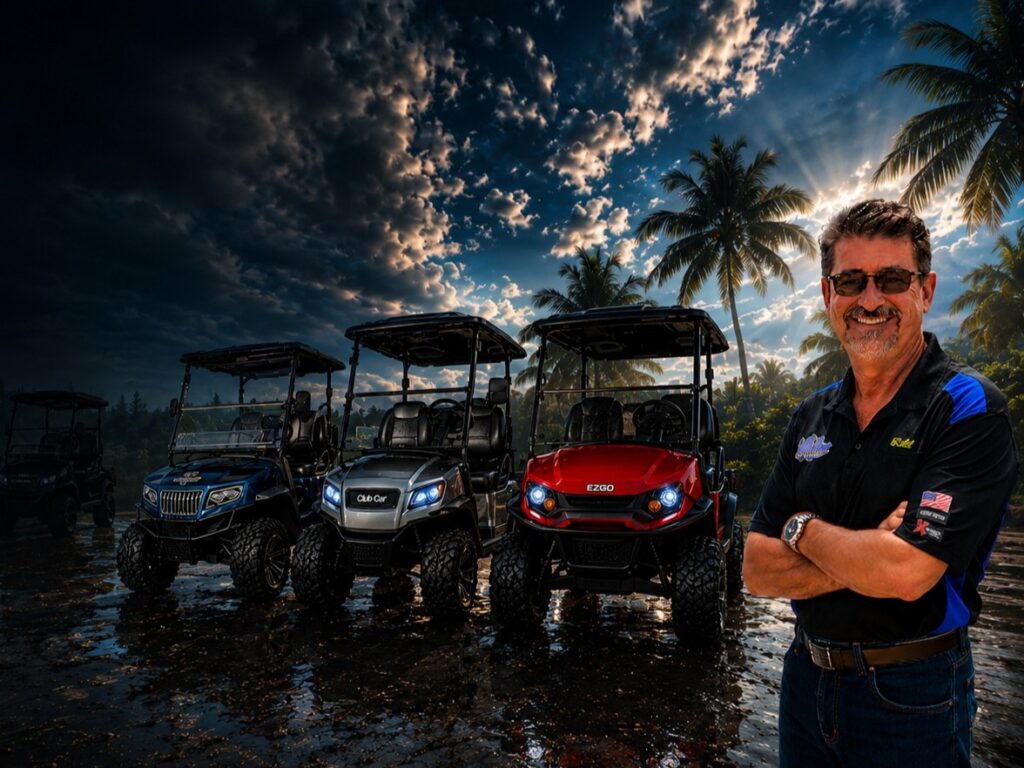
13 Best Golf Cart Brands 2026 Buyers Guide
Learn what’s important before you buy!
Table of Contents
Table of Contents
Golf Cart Brands – Market Research
- 4 of Florida’s Top 10 Selling Brands in 2024 have since collapsed or are fading.
- 52 brand names were sold in Florida in 2024. 20% of them are simply gone in 2026.
- 70 brands have been sold in Florida so far this year. 40% of them (28/70) didn’t exist in the market two years ago.
Buyers are confused, and some are getting burned…
Best Golf Cart Brands 2026 – look at the market through the eyes of an industry insider.
Tracking the Market – About our Numbers
Golf carts are essentially unregulated — no title, no registration, no federal safety standard. Nobody counts them, so nobody really knows how many are sold or by whom. Street-legal LSVs are the opposite: they’re federally regulated vehicles under FMVSS 500, and every one sold in Florida must be titled and registered with the state. That paper trail can’t be spun by marketing departments.
Because of that, we believe LSV registration data is the most reliable indicator of true brand market share available anywhere — and that a brand’s trajectory in the LSV marketplace tells you a great deal about its overall health, dealer network, and staying power. Our numbers are based on Florida FLHSMV new LSV registration records covering full-year 2024, full-year 2025, and 2026 year-to-date through July. Figures reflect new dealer-registered units in Florida unless otherwise noted; 2026 counts are partial-year and can only grow. Florida is the largest LSV markets in the country, so while these are Florida numbers, we believe they’re a fair proxy for national trends. Registrations are recorded by the state’s make code, which occasionally differs from the brand name on the cowl.
Organized in Tiers – Top to Bottom
Grouped by
- Brand Reputation
- Price Range
- Consumer Experience
- Repairability
“My Take”
Experiences shape what is written.
Raw
Real-World
My Take: Read more…
Drop the box down for the meat. or just skip
Not Listed
Brands Too New
Re-Branded Imports
Combinations of Both
–
Best Golf Cart Brands – Tier I
Proven OEM Platforms
Best Golf Cart Brands begin with the brands that built the golf cart industry. EZGO, Club Car, and Yamaha have produced commercial-grade vehicles to American standards for decades. Many golf carts built by these industry giants are still in service 20–30 years later.
Their reputation was built in fleet and commercial environments, where reliability isn’t optional—it’s required. That track record still carries weight today.
Waves of Chinese golf cart caught the Big 3 sleeping on the American Consumer Market. It’s not like they couldn’t see them coming. I just don’t think they expected hundreds of thousands to quickly be dumped into the market.
Read more about what the Big 3 Legacy Manufacturers have been up to recently…
They definitely underestimated how much the public was going to like big display screens, LED lights, sound bars, and comfortable seating! These guy’s took it on the chin for a while.
Modern buyers now expect better ride quality, integrated technology, more features, and LED lighting systems. That shift has pushed these legacy manufacturers to reinvest after years of slower innovation.
A major advantage of brands in this tier is long-term support. Established dealer networks, consistent parts availability, and proven serviceability are still strongest here—and that matters more than most buyers realize, especially a few years down the road after a purchase is made.

E-Z-GO
My Take: Model Year 2027 previews promise even more as E-Z-GO unveils exciting new products, models, features, and expansion of street-legal LSV model variants. Read more…
E-Z-GO has consistently delivered low total cost of ownership for decades. That’s even more true today due to the success of their proprietary and exclusive Samsung lithium battery. Historically, E-Z-GO’s strength came from success with fleet and commercial applications – and a well-earned reputation for reliability.
But focus on fleets left consumer models behind in features and comfort.
That has now all changed.
E-Z-GO made major investments into the consumer market. In 2026 we started to see the results with updated styling, premium seating, extra storage, and quality technology packages.
Model Year 2027 promises even more exciting new products, models, features, and expanded street-legal LSV variants.
Bottom line:
E-Z-GO is one of the most balanced and proven platforms on the planet—with strong dealer support and long-term reliability that makes this brand a very safe place for most buyers to start. New models and features will make them like what they see. E-Z-GO quality and support network will keep them happy for years.

Club Car
My Take: Club Car’s premium feel and strong reputation for build quality appeals to buyers looking for fit, finish, and brand recognition. Read more...
Like E-Z-GO, their reputation for reliability, dealer network strength, and parts availability is excellent and well-earned.
The aluminum frame has always been Club Car’s claim to fame and is often mentioned by shoppers comparing brands.
This iconic manufacturer’s core business is also commercial golf course carts, but similarly to E-Z-GO, Club Car has renewed its interest in the consumer market.
Club Car’s dealer network is solid, and parts availability is good to great—certainly on par with that of E-Z-GO. Some lithium-related reliability concerns have been noted, but Club Car is clearly Tier 1 and continues to compete with E-Z-GO for best-of-the-best ranking.

Yamaha Golf-Car Company
My Take: Read more…
Yamaha golf carts are one of the Big 3 and clearly belong in this tier. The brand has earned a strong presence in the commercial golf course market and is known for solid mechanical reliability.
Their gas engines, in particular, have a reputation for being quiet and exceptionally smooth.
That said, in today’s consumer market, Yamaha has been slower to adopt newer features, technology, and electric-focused innovation compared to other OEMs.

Frames – Aluminum vs Steel
My Take: Read more…
No golf cart brand comparison would be complete without addressing one of the most common questions that buyers often start with – Is an aluminum frame better?
Club Car is known for its aluminum frame, while E-Z-GO’s frames are e-shielded steel.
Aluminum vs steel frame rails have been debated for decades in the automotive and truck world.
Today, Ford argues that aluminum is lighter and improves payload. Chevy counters that steel is stronger and costs less to repair.
Ask ten people which one is better – Ford or Chevy? You’re likely to get a passionate response based on what they’ve had a good experience with, or what their dad or Grandpa owned.
The Club Car vs E-Z-GO conversation often goes similarly. These brands have been around forever and many identify with one or the other.
Aluminum frame rails were helpful when batteries had acid in them. Lithium batteries have now nullified that argument. In fact, an aluminum frame can make some repairs more difficult because aluminum and steel can chemically fuse together. When they do, suspension repairs can be more difficult and expensive.
For coastal areas where a garage is unavailable, we offer undercoating to protect not only the frame, but also the suspension, steering, and any other exposed steel surfaces.
Both brands are established, reliable, and capable with commercially proven frame rail systems.
Ultra-Premium Luxury LSV
Tomberlin – In a Category of Their Own
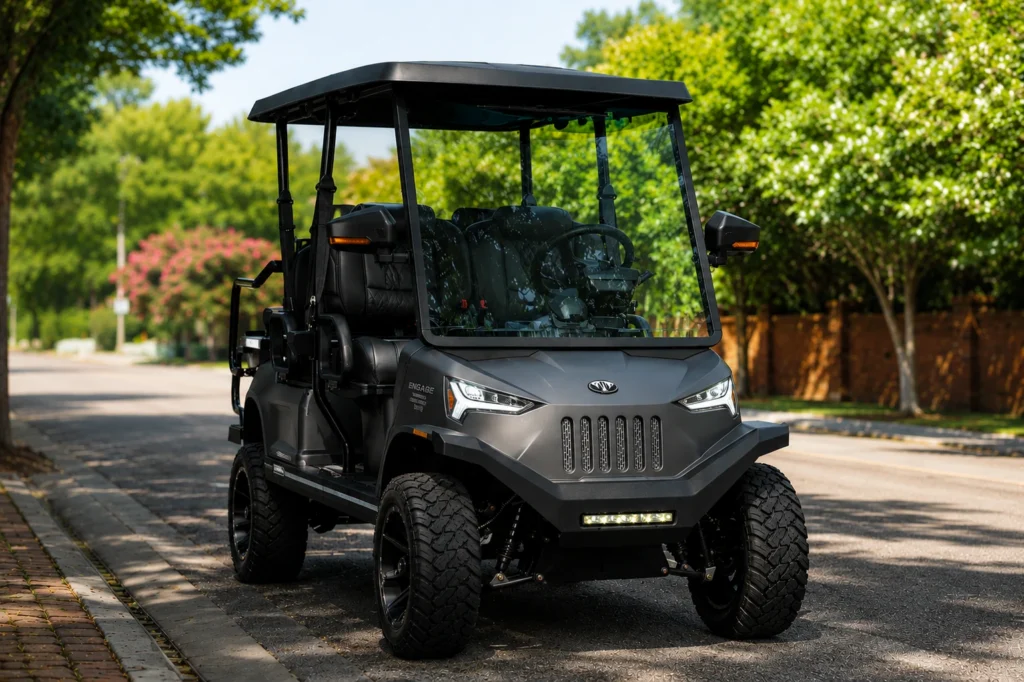
My Take: If BMW, Porsche, or Land Rover appeal to you, then Tomberlin fits that mindset. Read More…
Tomberlin sits in a very different category than any other. This brand builds true street-legal LSV vehicles in the USA from the ground up. With strong focus on safety, compliance, and automotive-style driving experience, Tomberlin enjoys a very loyal brand following.
They are also priced accordingly—typically in the upper $20k to lower $30k range—which naturally puts Tomberlin into a low-volume, premium segment. These aren’t impulse buys or “value” purchases. The buyer here is usually looking for the best overall experience and is willing to treat themselves to it.
Tomberlin and parent company Columbia are rock-solid American companies. Columbia has built commercial golf carts in Wisconsin for over 45 years with heritage that includes AMF and Harley-Davidson brands of golf carts. Tomberlin and Columbia have consolidated both brands into a new manufacturing plant in Aiken, South Carolina.
The iconic Tomberlin E-Merge models are still in production, but the redesigned and updated Engage is peerless. Tomberlin bridges the gap between today’s best street-legal LSVs and performance/luxury automobiles while retaining the convenience of that “jump in and have fun” golf cart experience.
Not every vehicle fits neatly into traditional golf cart tiers. This is one of them. But does Tomberlin fit into a best-brands conversation? Absolutely.
Best Golf Cart Brands – Tier II
Quality – Domestic Ownership – Mixed Manufacturing
Tier II brand names in this Best Golf Cart Brands Guide are domestically owned and usually have some legacy brand veterans who understand support expectations.
Typically priced between legacy brands, and mass-produced imports, brand names in this tier usually have a better fit-and-finish and use higher quality components than mass-produced imports as well.
In this tier, manufacturing is a blend of domestic and imported that varies by brand.
Read more about the potential differences between Tier II brands…
Tier II brands should be purchased locally from trusted top local dealers who are invested in the brand-specific diagnostic computers, other necessary tooling, parts inventory, training and time/experience curves.
Parts availability, supply chain consistency, technical support, and how warranty claims are actually handled – that’s where the separation happens and long-term satisfaction is earned. The dealer that you buy from is a big part of that.

Atlas Carts
The Atlas ownership group includes U.S. legacy brand and dealership veterans who clearly understand what matters in the real world. This understanding shows up in a real commitment to support.
My Take: Atlas feels different from many newer brands entering the market. It shows in how the company is being built, not just the product itself. Read more…
These things are not typical of what you see from most newer brands.
Ongoing investment in systems, technical infrastructure, and a steady move toward more U.S.-based manufacturing differentiate this brand.
The Atlas product lineup also backs the differentiation up. Component selection is intentional and higher-end. Ride quality is exceptionally smooth for both lifted and non-lifted models – which isn’t easy to get right. Handling and braking performance are also strong in both standard golf cart models and faster street-legal LSV variants.
The One 4F is an all-new model that was introduced at this year’s PGA show. Updated styling, premium seating, ride quality, innovative storage solutions, and technology packages make this potentially a game changing model.
Overall, Atlas feels like a veteran company that understands the long game—and is building for it.

Epic Carts
My Take on Epic Carts Read More…
Epic looks the part for this tier—sharp, feature-rich, and priced accordingly—but there are a few considerations beyond the first impression. The look, feel, features, and pricing all align well with Tier II expectations. At the same time, this is still a relatively new brand with a short track record.
Some ownership overlap with Tier III brand ICON Electric Vehicles is concerning (see Tier III).
Overall, Epic presents a polished, higher-end option that belongs in this Tier. Long-term confidence ultimately comes down to support structure and critically important dealer execution.

Bintelli Electric Vehicles
Read My Take on Bintelli Electric Vehicles Read More…
Bintelli aligns well with the Tier 2 profile: domestically owned company with hybrid manufacturing, modern design, and in-between pricing. Repairs of Bintelli vehicles have revealed solid, quality components and good-looking, well-equipped golf carts.
Interestingly, Bintelli began with a direct-to-consumer online sales model. Later they experimented with adding a few dealers, but ultimately it appears that they’ve opted to continue to sell directly through a small number of corporate owned locations in Florida.
A few local brave souls purchased this brand online. They ultimately ended up in our shop for one reason or another. In one very memorable instance, the poor fellow waited several months for brake parts.
Overall, Bintelli appears to be a compelling product on the surface, but long-term ownership experience is always going to be highly dependent on support. This distribution model highlights the potential pitfalls of buying golf carts online.

Honor LSV
Read My Take on Honor LSV Read More…
Honor LSV is a deserving inclusion in Tier II. Admirably, Honor is dedicated to manufacturing in the U.S.A., and opened a new plant in South Carolina in 2023.
We had a chance to test drive one last year and came away impressed. This is clearly not a mass-produced import golf cart. It’s big and built like a tank. This is a golf cart or low-speed vehicle that a big man will not feel cramped driving.
A closer look in the WilDar shop also satisfied our technicians that this is a well-built low-speed vehicle. While still a very young brand, Honor LSV stands out and feels like a company dedicated to the long haul. We liked what we saw.
Best Golf Cart Brands – Tier III
Icon – Evolution – Denago – Dach – Kandi
This segment has grown faster than any other category in the golf cart market over the past five years. The names are well known – Icon, Evolution, Denago, Dach, and Kandi.
The formula is simple — and effective: mass Chinese manufacturing, aggressive styling, large display screens, and low upfront pricing. On the surface, they offer a lot for the money.
My Take: We have plenty of experience with these brands. Consumer experiences and satisfaction reviews vary dramatically on social forums. Read More...
Some social media posts and reviews sing praises while others talk extensively about critical repair delays due to parts availability and extended downtime.
It’s important to understand that total ownership experiences will vary significantly compared to higher quality products.
For some, the trade-off in price is worth taking that chance.
How are they holding up? What has the total ownership experience added up to so far on a brand by brand basis? Read on for the real stories…
All Buyers Should be Aware of This

US Dept of Commerce Determination affecting all Tier III parent manufacturers and importers – Unfair trade practices by Peoples Republic of China include heavy subsidation and dumping products under cost for market share. Linked Here

Icon Electric Vehicles
My Take: Icon Electric Vehicles changed the game. Read more…
Around 2017, Icon introduced themselves to the market with fun paint colors with coordinated seat colors. Icon’s display screen with speedometer was novel for the time.
Lower than market pricing with faster-than-market speeds were a hit with the public and we sold a lot of them.
Early models were known for rough riding low-profile tires, and thin, hard seat cushions.
Lack of parts was the greatest source of customer dissatisfaction that we ran into.
Track Record
Icon EV now has a longer track record in Florida than others of this group. Icon still hasn’t figured out parts, but aftermarket sources fill some of the gaps.
Inconsistent components and limited technical documentation create higher labor charges. These issues make repairs typically cost more than they should be.
Crashed cars result in total losses more often than they are repaired Trade-in values are relatively lower as a result.
History Shows
The sales playbook of fun colors, low prices, and fast cars worked. Icon defined the winning sales strategy for importers.
Others would soon follow the business model…
Today
Buyers who want to understand how thin the separation can be between some U.S.-market brands and overseas factory-direct listings can compare similar LVTong models on www.made-in-china.com.
Today, this brand has drawn increased scrutiny from U.S. Customs and Border Protection after landing in the middle of a Countervailing Duty Investigation.

Evolution Electric Vehicles
My Take: Evolution Electric Vehicles was Icon’s main competitor in this price segment early on with the venerable Classic series. But basic colors and seats limited early sales volume – they just weren’t attractive… Read more
But in 2021 Evolution started color coordinating cushion and paint colors like Icon had been before them.
Added display screens with Bluetooth sound breathed life into sales.
Evolution hit its stride with the introduction of the D5 model lineup in early 2023.
History Shows
This model introduction began a couple of years of market dominance.
Mass-production competitors in China noticed. Zhejiang Taotao ramped up to join the battle against Chinese rival Xiamen Dalle (Evolution, HDK, Tara among other alias names)
Insiders say Evolution panicked. Whatever the reason, they cut +/- $2000 off of the MSRP of their lineup.
Zhejiang Taotao (Denago) came to America anyway.
For a while, both mass-production giants from China dumped golf carts into the market seeking to dominate with low-priced volume.
Evolution hung tight with low prices for a while.
Track Record
Evolution-branded lithium batteries have long been one of this brand’s most troublesome sources of dissatisfaction and complaint.
Like Icon, crashed cars are typically total losses due to damage to thin frames and weak components.
Repair times and costs are typically higher than average.
Trade-in values are also relatively lower as a result. 2026 market data through July shows this brand is the #1 brand in Florida’s used transfers against new sales – a nearly 7:1 dump ratio.
Non-transferrable warranties have caught many second buyers by surprise.
Social media posts and reviews show a wide disparity in customer experience depending on region and dealer. This brand blazed the mass-production, support-light import giant’s playbook.
Today
Today, the popular D5 models are rare or unavailable. Evolution also discontinued producing street-legal model variants.
New models have not been received as well as the D5.
Factory direct golf carts from manufacturer HDK (parent company) can also be found on www.Made-In-China.com by filtering for HDK brand golf carts.
Evolution, like Icon before them has also drawn increased scrutiny from U.S. Customs and Border Protection as well as unfair trade practices.
Evolution’s once bright light has now dimmed considerably with a 98% collapse from their 2024 peak.
Denago EV
My Take: Zhejiang Taotao entered the U.S. market with Denago in 2024, hot on the trail of Xiamen Dalle’s Evolution and its reported 27% market share…. Read more:
Industry insiders intimate that the two Chinese companies have no love lost. See Xiamen Dalle’s Evolution block if you didn’t catch it earlier.
Track Record – Incomplete
Reported early ownership experience tends to mirror what we’ve already seen from this category.
Long-term considerations like parts availability, serviceability, and warranty consistency are still developing. Most are still under warranty – for now.
Many buyers have complained about tire ride quality, with tires often replaced early. Complaints about fit and finish issues also appear to be higher than are even typically seen in Tier 3 and 4 cars. These are the same types of issues previously seen with the sales-focused, high-volume importers discussed earlier in this tier.
Today – Still Developing
The long-term questions for Taotao Denago buyers will revolve around commitment to support infrastructure, as much as response to tariffs and additional CBP scrutiny and the same unfair trade practices rulings as others in this group.
Denago golf carts cannot currently be found on www.Made-In-China.com, but a recent search located them for sale on Alibaba under Tao Motor as well as Denago.
July 2026 Recall Update: Denago EV Corporation recalled approximately 34,136 Nomad, Rover and Scout low-speed vehicles because certain vehicles may not produce the pedestrian-warning sounds required by Federal Motor Vehicle Safety Standard No. 141. Affected owners should check their VIN through NHTSA or contact an authorized Denago dealer for the no-cost remedy. Read our full Denago LSV recall summary.

Dach Vehicles
My Take: Time will tell on this brand as their history is short. Will it be different? Read more…
History – It’s Short
The most recent Tier III mass-produced, support-light sales entrant into the market is Dach Vehicles.
Their website does its best to portray U.S. manufacturing, but public records reflect a different picture.
Based on publicly available records and product similarities, Dach appears closely connected to Dachi Intelligent Automobile (Rizhao) Co., Ltd.
Dachi (Rizhao) is named in the USITC Final Countervailing Duty Investigation regarding unfair trade practices. The brand names you see for sale are not always listed in these reports. The Chinese manufacturers and exporters shipping them are.
Similarities to others – Xiamen Dalle (Evolution), LVTong (Icon), and Zhejiang Taotao (Denago), don’t seem to end there either.
Track Record – Little
Inspection of Dach Vehicle components revealed quality similar to that seen on other brands in this tier as well. Repair costs are expected to be higher than average for the same reasons. Trade-in values are currently unknown, but they are also expected to be below industry benchmarks.
Reported early ownership experiences also seem to follow established patterns.
This brand sure looks like what we’ve seen before.
Today
Are they willing to invest in domestic manufacturing or will they navigate border tariff enforcement differently?
Will similar business models have different results? Time will tell.
Kandi America
My Take: Kandi went after “big fish” and landed huge distribution deals through big box retail stores like Tractor Supply, Lowe’s (labeled “Coleman” like the coolers), and Walmart. Read more…
Kandi fits cleanly into this tier with desirable features, styling, and similarly aggressive price points.
History Shows
But this brand approached the U.S. market differently than others in this tier. Instead Kandi went after “big fish” and landed huge distribution deals through big box retail stores like Tractor Supply, Lowe’s (labeled “Coleman” like the coolers), and Walmart.
Big box stores seem to be backing away from the golf cart market. Some of the Kandi product inventory in Lowe’s recently was seen in poor condition and highly discounted.
As the big-box market seems to slow, Kandi appears to be putting more effort into dealership distribution. But sales there appear to be slow as well and models I’ve seen are also discounted into cut rate pricing ranges.
Track Record
Big-box retail stores don’t have service departments, and each distribution channel requires a separate support network — where accountability has thus far rarely been clearly defined.
Product reviews in my shop have been mixed with varying degrees of quality between models that we’ve worked on.
We’ve been authorized to perform some warranty repairs for a few of the golf carts purchased through big-box retailers.
A couple of buyers from local dealerships asked us to help when they were dissatisfied with the dealer they bought it from. Kandi refused that and required it’s return to the selling dealer.
In all cases, communication and parts supply have been slow and challenging.
For Kandi, the lack of a reliable repair network seems to be impacting their reputation and sales.
Today
Kandi America seems to be operating on a business plan than the others in this group.
Their relationship with Chinese manufacturer Kangdi Electric Vehicle (Hainan) Co., Ltd is direct, and clearly stated. This transparency is very different and noteworthy compared to others in this group.
Kangdi Kandi long-term prospects in the USA likely depend on execution of plans to establishment of a level of domestic manufacturing.
For buyers, questions should revolve around commitment to support infrastructure.
But if customer support were truly central to the business model, buyers would likely be seeing that more clearly by now.
Kangdi Electric Vehicle (Hainan) Co., Ltd is also named in USITC’s final determinations regarding countervailing duties and unfair trade practices.
How this company responds to these challenges will determine their future in the American market place.
Best Golf Cart Brands – Bottom Tier
Relabled Imports
At this level, the brand name on the cart tells you very little.
Made-in-China currently shows 452 Golf Cart manufacturers & suppliers.
In many cases, the “brand” is an importer/distributor/reseller buying carts from an overseas factory and dressing them up with custom colors, seats, wheels, decals, logos, and badging.
Dealer support matters more here than anywhere else.
Some dealers are committed to the products they sell and invest in them. Others simply rotate through brands based on which one is offering the lowest price at the time.
Dealers who frequently change brands, combined with names you’ve never heard of, are where shoppers should be most cautious.
Read more…
Anybody with enough capital can use Alibaba, Made-in-China, or direct factory sourcing to order a batch of Chinese golf carts with unique looks and branding.
If the importer disappears, changes factories, or cannot supply parts, the customer may be left with a cart that is difficult to repair.
Here’s How That Shapes What We Stock and Recommend
We Carry What We Believe In and Service What We Sell
Our Job
Is to help you understand the differences and choose the right fit, the first time. We chose years ago what Best Golf Cart Brands we are going to represent and have invested in them heavily.
We Don’t Stock Tier III or IV Brands
In that price range, we offer customized refurbished EZGO Elite RXVs converted to street legal LSVs as well as EZGO Factory Certified Pre-Owned.
We believe that these street legal golf carts offer better value in the long run for what you are going to pay.
The Best Golf Cart Is…
The one that still makes you happy a few years after you bought it. That’s what this Best Golf Cart Brands Guide was built on.
It’s also how we run our dealership.
Start With a Dealer You Trust
And if you’re in the Port St. Lucie or Treasure Coast area, we’d like to earn that trust.
Come see us — or start browsing below.
