
By Bill Huston, WilDar Golf Carts & Trailers
There’s no Blue Book, Black Book or NADA Value Guide for golf carts or LSVs. So who decides your golf cart trade-in value?
The dealer does, and most won’t tell you how. I will.
It starts with the next buyer, not you.
Every trade number starts with one question – what will this cart sell for on my lot? Then two more. What will it cost for me to get it ready, and what do I need to make on it to pay the bills?
Selling price, minus the work, minus the profit. What’s left is your trade number. That’s your golf cart trade-in value.
That’s it. Car dealers do it. Truck dealers do it. I did it for years with used trucks at a Freightliner dealership before I ever sold a golf cart. Same math.
Part math. Part art form.
The math is the easy part. The art is the first number. What will it sell for? Here’s what I look at.
Condition. On a golf cart, miles matter far less to me than the condition it’s in. Was it garage kept and maintained? Left outside? Used and abused? Or somewhere in between?
Batteries. Lithium or lead acid? How old?
Trim. A loaded cart brings more than a base one.
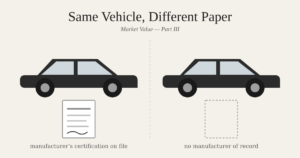
The title. Was it built as a street-legal LSV with a certification label? Or was it a golf cart converted later? A converted golf cart requires written disclosure on resale which protects consumers. Honesty is not optional in this regard, nor should it ever be.
Support. Can I get parts for it? How fast? Who answers the phone?
Support swings golf cart trade-in value the most.
If the brand is supported everywhere, we can sell that cart and stand behind it while looking somebody in the eye with confidence when they buy it.
If reliability of the brand has not been the best and support is slow, then the number must reflect that. On the other hand, if support takes real effort and parts are difficult to obtain and it’s hard to get somebody to answer the phone then I know it’s going to cost more money to get ready for sale and buyers are going to want to pay less.
Check it yourself.
Before you ask anybody for a golf cart trade-in value, do three things.
- Look at your cart the way a stranger would.
- Know your batteries. What kind, and how old.
- Call for a part. Ask if it’s in stock. See who answers the phone.
That last one tells you what the dealer already knows.
Golf cart trade-in value and the sales tax credit
In Florida the amount of the trade-in reduces the sales tax you pay by 6% of the trade value. Hey, every little bit helps, right?
Alternative – sell it yourself
Some people go this route and sometimes it makes sense. Just remember, if you don’t fix it up before you sell it then buyers are going to want it cheap. No trade-in means no 6% sales tax credit on the value. And if your neighbor buys it, remember who he’s going to call first if it ever breaks down.
More in this series: Automotive History: Every New Industry Buries Most of Its Brands · Gray-Market Vehicles: The Discount Today, the Cost Tomorrow · What the Law Protects When a Brand Goes Away — and What It Doesn’t · Golf Cart Warranty: Parts and Labor, or Just Parts?