By Bill Huston, WilDar Golf Carts & Trailers
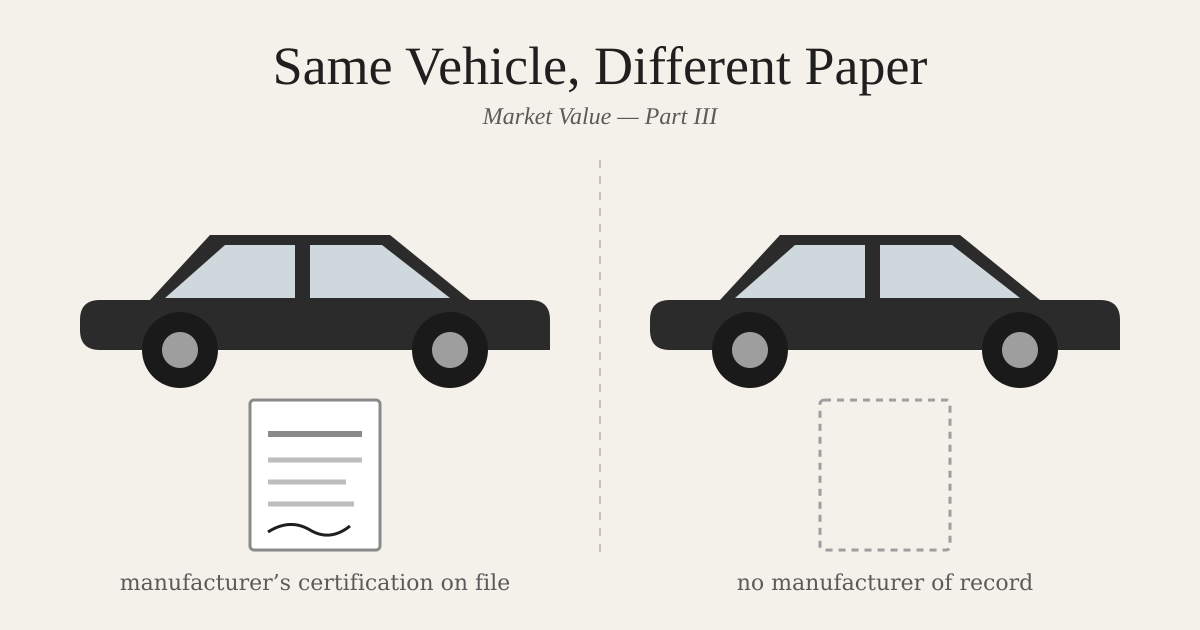
Last time I wrote about what every vehicle industry does to most of its brands. This time it’s market value, from one side of the counter — the buyer’s. Twice in the last forty years, Americans bought gray-market vehicles that looked exactly like the ones next to them but carried different paper, or none. Both times the public record kept track of what the buyer saved on day one and what he found out afterward. I’ll keep to what that record says.
Certification: What it is and why it matters for safety and resale
The automobile went seventy years without a federal safety standard. The National Traffic and Motor Vehicle Safety Act was signed September 9, 1966, and the first standards took effect January 1, 1968. By the agency’s own estimate, those standards have prevented more than 860,000 deaths since. The LSV got its standard in 1998. The standard was never the problem in our industry. Who stands behind the certification is — that’s what this article is about.
1984: the gray-market Mercedes
In the early 1980s you could buy a Mercedes two ways. Through the franchised dealer, built and certified for this country by the factory. Or through an independent importer who bought the same car in Europe, shipped it here and paid a conversion shop to make it legal. The Washington Post reported in December 1984 that more than one in five Mercedes entering the United States that year came in the second way. The General Accounting Office counted about 2,400 such cars in 1980 and about 67,000 in 1985.
Day one. The Post put the saving at 15 to 40 percent off the franchised price. That was the whole case for the car, and it was real money.
The first year. Here is what came with the discount, in the words of the period press. No manufacturer warranty. No recall notices — a federal safety official told the Christian Science Monitor in 1985 that gray cars sat outside the recall system entirely. The compliance paperwork the buyer needed before he could register the car took an average of six and a half months, sometimes a year, during which the car was his and the road was not. When he went to the franchised dealer for service, TIME reported in 1984, some dealers refused to touch a converted car. When he tried to trade it in, some refused that too; the Post found dealers who would take a gray car but would not put it on their lot. One major insurer would not write a policy unless the car was fully compliant. The manufacturer itself warned, in 1985, that parts, service and resale value could all suffer.
What he actually owned. The dealers’ association inspected gray cars in 1984 and found 82 percent missing required safety equipment and 45 percent with no U.S. identification plate. The manufacturer’s inspection of 1,114 cars found 96 percent non-compliant. A 1984 emissions test passed one car out of 27. GAO’s 1986 audit examined five cars in detail; none met every standard. The agency responsible, GAO wrote, “neither tests the vehicles nor visits the firms” that did the conversions. The buyer had no way to know which of those cars was his. Some never got a car at all: in Dallas in 1983, D Magazine reported buyers who put about 10 percent down with brokers and never saw the vehicle.
When the sellers left. The buyer’s importer was one of roughly 200 member companies in the trade group — and one of 2,458 importers of record that Customs counted in four districts, 193 of them in Tampa. Then the dollar fell. Gray imports dropped about 64 percent in a single year, from roughly 66,900 in 1985 to 23,900 in 1986, before Congress had passed anything. The Imported Vehicle Safety Compliance Act followed in October 1988, and a former converter told Autoweek that after it the importers “dropped like flies.” By 1992 fewer than 300 gray cars a year came in. The buyer who needed a part, a correction to his paperwork, or the shop that had signed his conformity papers was looking for a business that, in most cases, no longer existed.
Long term. A Mercedes owners’ club buyers’ guide records that gray cars trailed U.S.-market values for about twenty years, and that “true miles unknown” is common on them because instrument clusters were swapped during conversion.
2008: the scooter decade
Twenty years later, two wheels. In 2004 the trade press counted more than forty scooter importers in the United States, up from under a dozen a decade before, and warned that many had no parts supply behind them. By 2008 the industry council estimated a record 222,000 scooters sold here, plus thousands of Chinese units it could not count.
At the counter. One Chinese factory sold the same scooter under eight U.S. brand names. The buyer’s invoice said one name; the manufacturer code in his VIN said another. Identical identification numbers under different brands produced conflicts at state title desks. Pennsylvania began checking every Chinese-built application against the manufacturer’s VIN registration in September 2008 and rejected about 91 percent in the first three months. The rejected buyer was sent back to the seller with the scooter and the bill of sale.
When the brand closed. An importer with about 400 dealers at its 2008 peak ceased operations in February 2010. Its buyers’ warranties went with it: the factory’s own U.S. arm did not honor them, and the company that bought the importer’s assets that November disclaimed them in writing. Dealers reported they could not find parts for three closed brands. One importer said in 2012 he was still holding ten to fifteen units waiting on factory parts that never came. A dozen private-label companies closed in 2009. The factory behind the eight brands relaunched under a new name with a new VIN code and sold direct — leaving the owners of all eight with a brand that no longer had a factory behind it.
The paper itself. On June 30, 2010, the Environmental Protection Agency voided emissions certificates it had issued in 2006 and 2007 to the U.S. arms of four Chinese makers, covering up to 200,000 off-road motorcycles and ATVs, after finding the applications had contained false or incomplete information. What they held was a vehicle whose certificate the government had cancelled – but they could keep riding.
2023: the title that came back in the mail
In September 2023 Georgia’s tag offices were told to stop titling imported mini-trucks. Owners who already held titles received letters demanding them back; they described the vehicles as worthless without one. Two bills to restore the titles failed, the second by veto in May 2025 — about twenty months. Michigan mailed off-road titles in 2024 to replace road titles it had issued itself, and reversed four to five months later after owners sued. Massachusetts announced a ban on June 18, 2024; one owner sold in a panic; registrations resumed September 18 — three months.
What Florida law says about paper that was wrong
Three things, no commentary. Section 319.25(1), Florida Statutes: a title improperly issued shall be cancelled, with notice to the holder. Section 319.14: a branded title must be disclosed in writing before sale and in advertising, and the brand stays for the life of the vehicle. And Kelley Blue Book’s published rule of thumb for any clouded title — salvage, rebuilt, reconstructed — is 20 to 40 percent off clean-title value, permanently.
Check your own paper
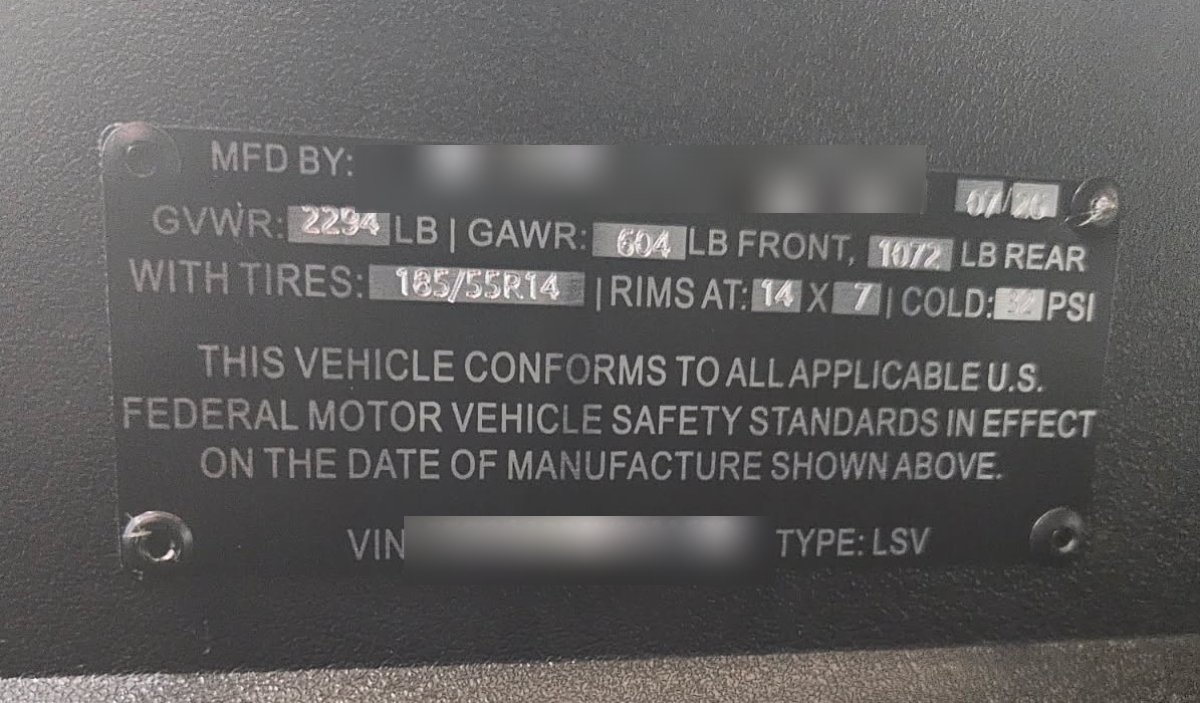
Three free lookups, five minutes. vpic.nhtsa.dot.gov — type your 17-character VIN; it should return the manufacturer, the model year and “Low Speed Vehicle.” vehiclehistory.gov — the federal title-history system. NICB VINCheck — stolen and salvage records. Then find the certification label. On a car it sits by the driver’s seat; on a LSV it is usually pop-riveted on the driver’s side below the dash (federal rule 49 CFR 567.4). The VIN plate is a separate tag, usually riveted to the driver’s-side frame rail near the left front tire or a little further back. Compare the manufacturer’s name on the label to the one the decoder returned, and write both down. What the label has to say, line by line, is on our FMVSS 500 page.
More in this series: Automotive History: Every New Industry Buries Most of Its Brands · What the Law Protects When a Brand Goes Away — and What It Doesn’t · What’s My Golf Cart Worth? How Trade-In Value Is Figured · Golf Cart Warranty: Parts and Labor, or Just Parts?
The brand tiers are on the Best Golf Cart Brands 2026 page.
Sources cited: Pub. L. 89-563 (Sept. 9, 1966); NHTSA, “50 Years of Vehicle Safety Standards”; 49 CFR 571.500 and 63 FR 33194 (June 17, 1998); Washington Post, Dec. 16, 1984 and June 27, 1985; TIME, Dec. 17, 1984; Christian Science Monitor, July 18, 1985; D Magazine, Oct. 1983; GAO/RCED-87-29 (Dec. 1986); GAO/T-RCED-87-3 (Mar. 6, 1987); GAO/GGD-87-85 (July 1987); GAO/RCED-94-22 (1994); Pub. L. 100-562 (Oct. 31, 1988); Autoweek, Oct. 3, 2018; Mercedes-Benz Club of America Buyers Guide; Powersports Business, May 6, 2004 and June 11, 2012; Motorcycle & Powersports News (2010); Roadracing World, Nov. 2, 2010; PennDOT Bulletin 09-03 (Mar. 2009); EPA news release, June 30, 2010; Fla. Stat. 319.14, 319.25; Kelley Blue Book; The Autopian, Sept. 22, 2023, June 12 and Oct. 29, 2024, May 19, 2025; StreetsblogMASS, Sept. 25, 2024; The Drive, July 23, 2024.