
Golf Cart Conversion to LSV Street Legal in Port St Lucie
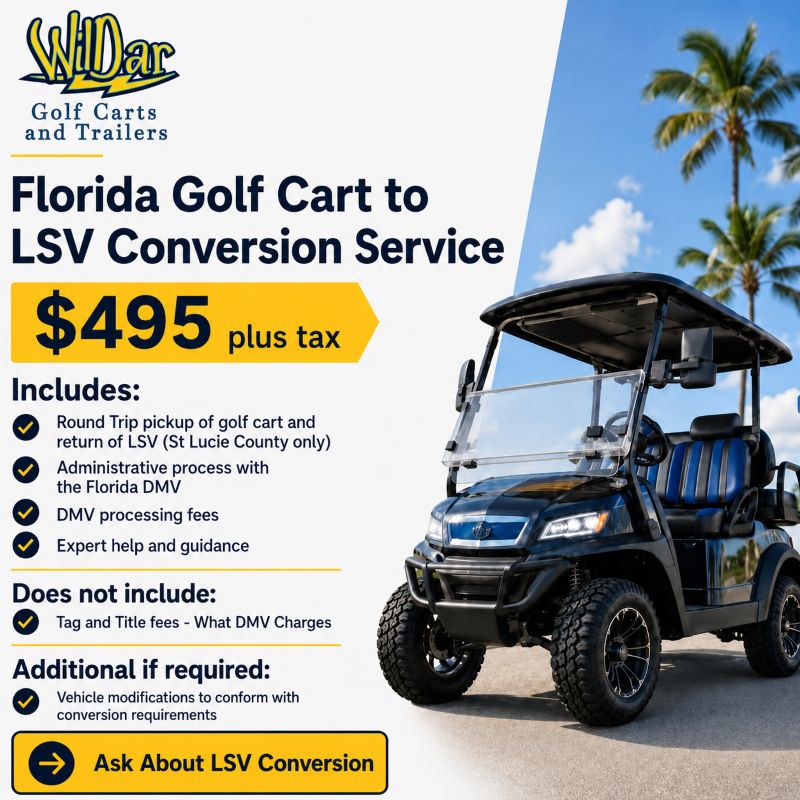
WilDar Golf Carts helps customers in Fort Pierce, Port St. Lucie, and the Treasure Coast understand whether their cart is a good candidate for conversion, what equipment is required, and what steps are involved before applying for title and registration.
Local Florida golf cart and LSV specialists serving Fort Pierce, Port St. Lucie, Tradition, and surrounding Treasure Coast communities.
Can Your Golf Cart Be Converted to an LSV?
Before spending money on parts, labor, or paperwork, the first step is determining whether your cart is a reasonable candidate for golf cart conversion to LSV conversion.
A cart may be a good candidate if:
- It is structurally sound.
- It can safely operate within the LSV speed range.
- It has or can support the required safety equipment.
- Ownership documentation is available.
- Parts and service support are practical.
- The total conversion cost makes sense compared with buying an already street-legal LSV.
A cart may not be a good candidate if:
- It is too old, modified, damaged, or poorly documented.
- It cannot safely meet speed or braking expectations.
- Required equipment would cost more than the cart is worth.
- It lacks the documentation needed for inspection, VIN assignment, title, or registration.
- The customer would be better served by purchasing a factory-built or already-compliant LSV.
Not sure which way to go? Read Converted Golf Cart vs LSV: 6 Things Florida Buyers Should Know.
Our Golf Cart Conversion to LSV Process
Step 1: Initial Cart Review
We start by reviewing the cart itself: make, model, year, condition, current equipment, speed capability, electrical system, brakes, tires, steering, suspension, and overall suitability for conversion.
Step 2: Documentation Review
Documentation matters. Florida conversion paperwork may require proof of ownership, bills of sale, receipts for conversion parts, a certified weight slip, and state forms used in the inspection and title process. FLHSMV guidance notes that converted golf carts must be street legal before applying for title and registration. The owner brings four photographs and the paperwork to a Motorist Services Regional Office for inspection, VIN assignment, title and registration.
Step 3: Required Equipment Planning
If the cart is a good candidate, we identify what equipment is already installed and what still needs to be added or upgraded. Required LSV equipment can include lighting, turn signals, brake lights, reflectors, mirrors, windshield, parking brake, seat belts, VIN-related requirements, rear visibility equipment, and other applicable items under federal LSV standards.
Step 4: Conversion Service
Once the scope is approved, WilDar installs or upgrades the necessary equipment. The goal is not just to “add accessories.” The goal is to perform the golf cart conversion to LSV process as practically and professionally as possible.
Know what you’re signing. On a Florida conversion, you sign the affidavit, Form HSMV 86064. The title will show the make as ASPT. The VIN will be a Florida-assigned number that starts with FLA. The cart will not carry a manufacturer’s certification label. Here is what Florida Form 86064 says, line by line.
Consumer Information Provided FLHSMV Including Golf Cart Conversion to LSV


Florida State Statutes Applicable to Golf Cart Conversion to LSV
Florida Statute § 316.2225 — Slow-Moving Vehicle Emblem
Form HSMV 86064 cites this section for the slow-moving-vehicle emblem on a golf cart modified to an LSV.
Florida Statute § 316.2952 — Windshields; Requirements; Restrictions
Form HSMV 86064 cites this section for the windshield cleaning device.
Florida Statute § 319.14(11) — Low-Speed Vehicle Converted to Golf Cart
Addresses the reverse conversion: a titled and registered low-speed vehicle converted back to a golf cart. The owner must contact the FLHSMV regional office, surrender the plate and title, provide an affidavit, pay the verification fee, and display the required “CONVERTED VEHICLE. Max speed 20 mph.” decal after verification.
NHTSA 49 C.F.R. § 571.500 vs FLHSMV and Florida State Conversion Statutes and Process
A golf cart converted to a low-speed vehicle in Florida must satisfy more than one set of requirements. The federal low-speed vehicle standard, 49 C.F.R. § 571.500, establishes the baseline equipment standard for low-speed vehicles. Florida then adds its own title, registration, insurance, inspection, affidavit, and road-use requirements.
For a new low-speed vehicle sold by a manufacturer, federal compliance is handled through the manufacturer’s federal certification process. For a golf cart converted to an LSV in Florida, the process is different: the applicant must complete Florida’s conversion/title process and sign FLHSMV Form HSMV 86064, certifying that the modified golf cart conforms to 49 C.F.R. § 571.500 and applicable Florida law.
What that form says, and what it doesn’t: Florida Form 86064: What the Golf Cart Conversion Affidavit Says, and What It Doesn’t.
