Golf Cart vs Street Legal LSV in Florida
The resources provided are for general information about subjects that we commonly hear people ask about and are not legal advice. The responsibility for knowledge of laws resides with you. Always conform to current requirements of the Florida DHSMV, your local authorities, and your HOA before driving on public roads.
Differences Between Golf Carts and Street Legal LSVs
The difference between a golf cart vs street legal LSV starts with speed, and how they were built to be used.
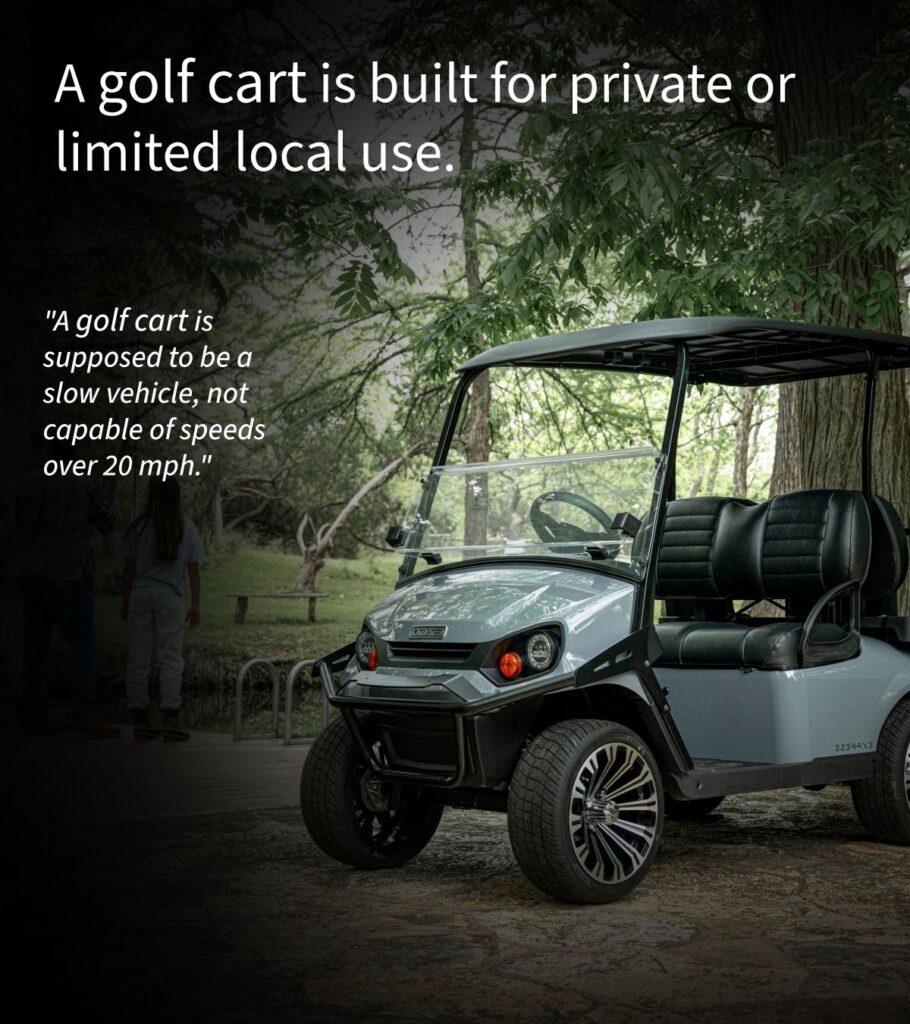
A golf cart is legally supposed to be a slow vehicle
In Florida, a golf cart is defined as a vehicle designed for golf-course/recreational use that is not capable of exceeding 20 mph.
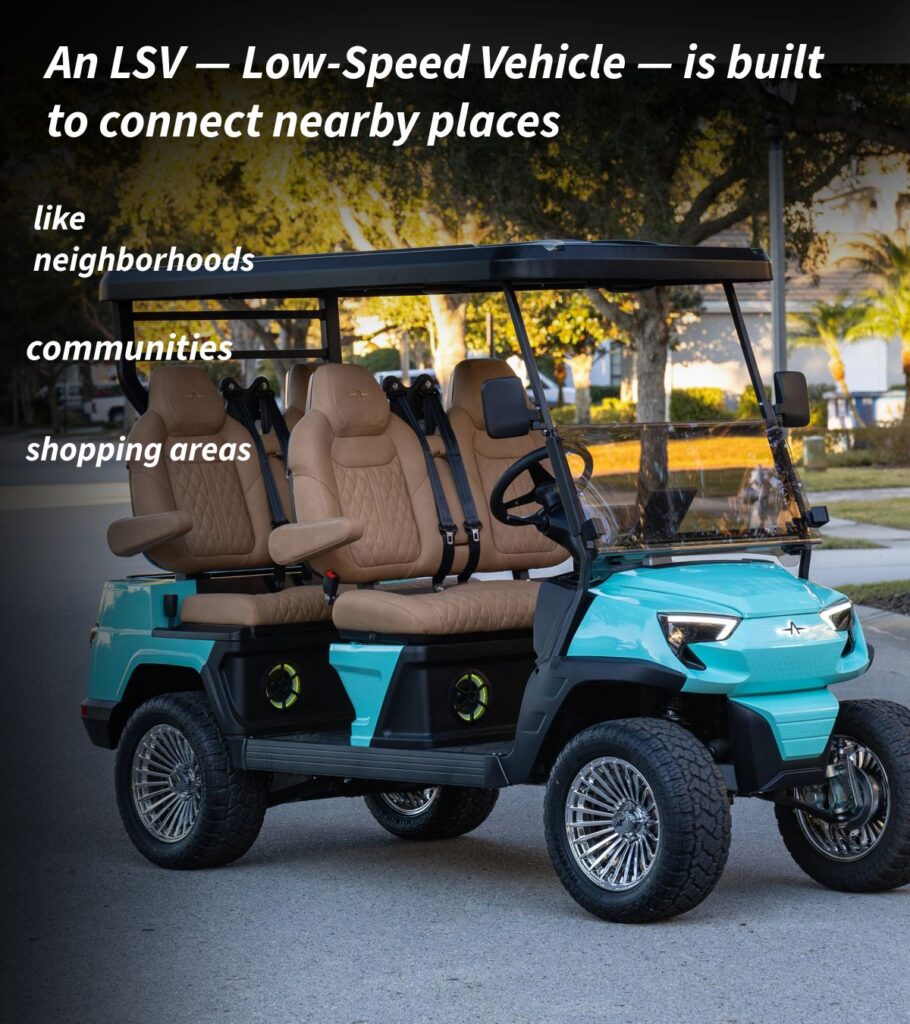
An LSV — Low-Speed Vehicle — is capable of speeds up to 25 mph
and built to connect nearby places like neighborhoods, communities, shopping areas, campuses, resorts, marinas, golf courses, and local streets.
That Small Speed Difference Creates a Major Legal Difference in Golf Cart vs Street Legal Comparisons
Once a cart is built or modified to go over 20 mph, it is no longer treated like a regular golf cart.
The important difference is not just the equipment list. An LSV is designed for short-distance, low-speed transportation on approved public roads, while a golf cart is designed for private or limited local use.
Golf Cart vs Street Legal – Manufactured vs Conversion in Florida
A factory-built Low-Speed Vehicle and a Florida-converted golf cart may both be titled and registered for use on qualifying Florida roads, but they do not reach that point the same way.
The important difference is not just the equipment list — it is who certifies the vehicle and how the vehicle becomes eligible for title and registration.
A Factory Built LSV is Certified Street Legal by the Manufacturer
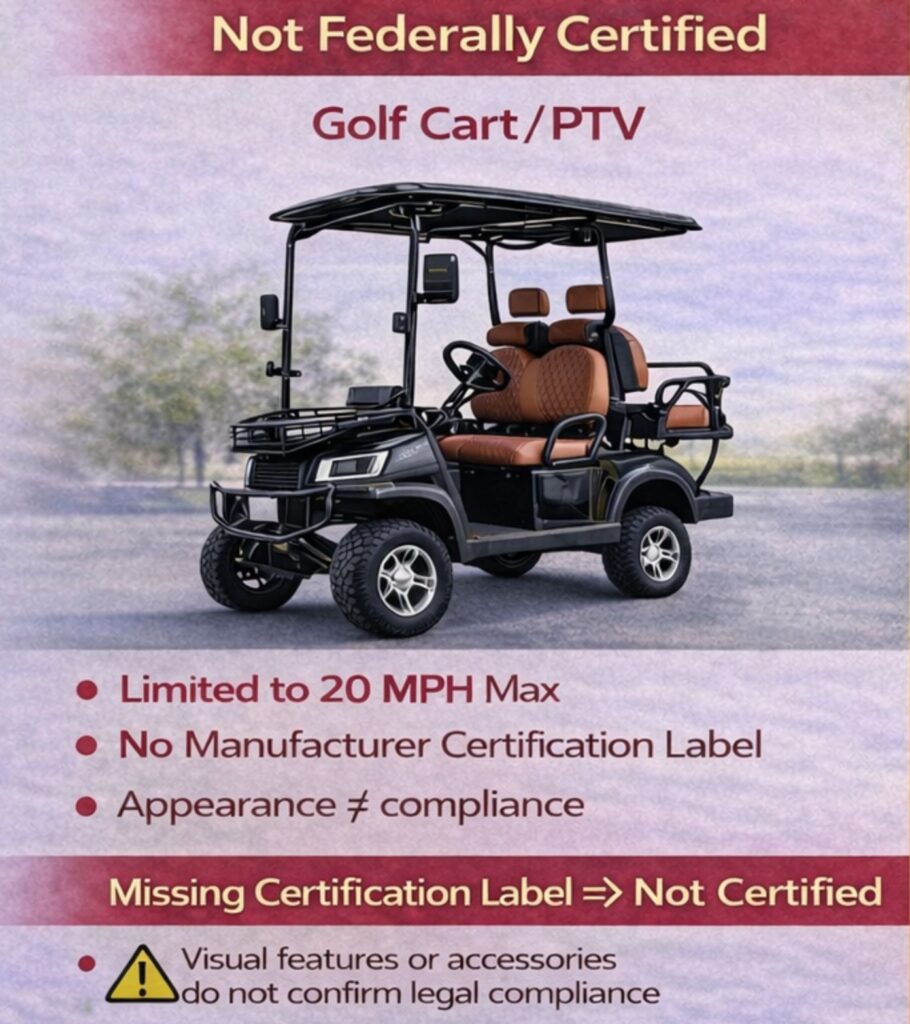

Certified Manufacturer LSV Requirements
- Manufacturer’s Certificate of Origin
- 17-digit VIN
- Federal certification label
- Manufacturer documentation showing the vehicle was built to applicable federal LSV standards
- Rear visibility system, commonly a backup camera/display system
- Pedestrian warning sound / quiet-vehicle alert, where applicable
- Manufacturer compliance testing, labeling, and certification responsibility
Certified Manufacturer LSV Administrative
- Title application and related registration documents
- Warranty registration, if applicable
For modern electric LSVs, the federal compliance package includes items many buyers may not immediately think about, such as rear visibility equipment and pedestrian warning sound equipment.
Another underappreciated difference is braking. Many manufacturer-certified LSVs are built with four-wheel braking systems, while many golf cart conversions begin as carts that were originally built with rear drum brakes.
It typically comes with a manufacturer’s certificate of origin, a 17-digit VIN, a federal certification label, and manufacturer documentation showing that the vehicle was built to the applicable federal LSV standards.
Florida Golf Cart to LSV Conversion Process
A Golf Cart Conversion is Different Than a Manufacturer Certified LSV
The vehicle starts life as a golf cart, then must be modified and submitted through Florida’s conversion process.
That process includes affidavits, a Statement of Builder, receipts for conversion parts, proof of insurance, photos, inspection/review, and assignment of a Florida identification number.
Florida’s conversion checklist focuses on items such as lights, turn signals, brake lights, reflectors, mirrors, seat belts, an approved windshield, a windshield cleaning device, a parking brake, horn, speed range, and weight.
Florida Golf Cart Conversion Requirements
- Headlights, taillights, and brake lights
- Turn signals and reflectors
- Mirrors Seat belts for all seating positions
- DOT-approved windshield with windshield wiper / cleaning device
- Parking brake and horn
- Maximum speed greater than 20 mph but not greater than 25 mph
Florida Golf Cart Conversion Administrative
- Proof of purchase of the golf cart
- Proof of purchase of modification parts
- Affidavits and builder statements as required
- Title application
- Photos of the golf cart after installation
- Proof of owner identity and address
- DMV / FLHSMV review and approval process
Note that if the golf cart was purchased from an individual and no sales tax was paid at the time, then the local DMV will require that sales tax be paid on the original purchase price upon registration.
That means a converted golf cart can become a Florida-titled LSV, but it should not be described as identical to a factory-certified LSV. The legal pathway, documentation, certification responsibility, and required equipment checklist are different.
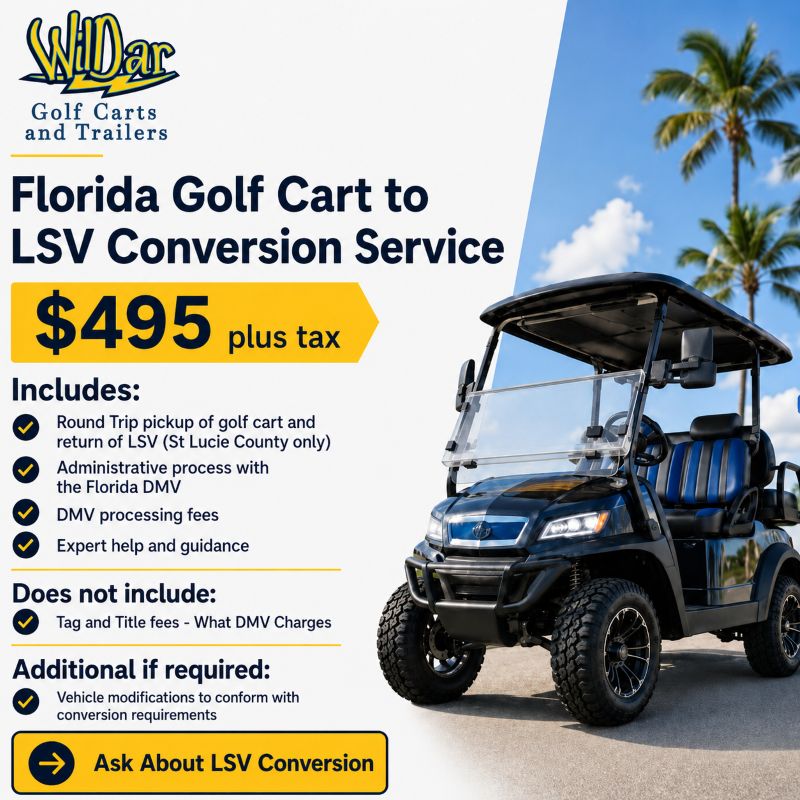
Need a Golf Cart Converted to a Florida-Titled LSV?
WilDar Golf Carts & Trailers helps customers through the Florida golf cart to LSV conversion process. We do more than install parts. We help make sure the vehicle is equipped, documented, photographed, and prepared for the Florida review process.
A proper Florida LSV conversion may include required lighting, turn signals, brake lights, reflectors, mirrors, seat belts, an approved windshield, windshield cleaning device, horn, parking brake, speed verification, insurance documentation, affidavits, builder statements, receipts, photos, and title paperwork.
The process can be confusing if you have never done it before. Our team understands the difference between simply adding “street legal” accessories and preparing a golf cart for Florida’s official LSV title and registration process.
If you already own a golf cart and want to find out whether it may qualify for conversion, contact WilDar Golf Carts & Trailers. We can review the cart, explain the likely requirements, and help you understand the next steps.