
Street Legal LSV FAQs and Golf Cart Answers – All You Need to Know
From Bill, Owner Wildar Golf Carts & Trailers,
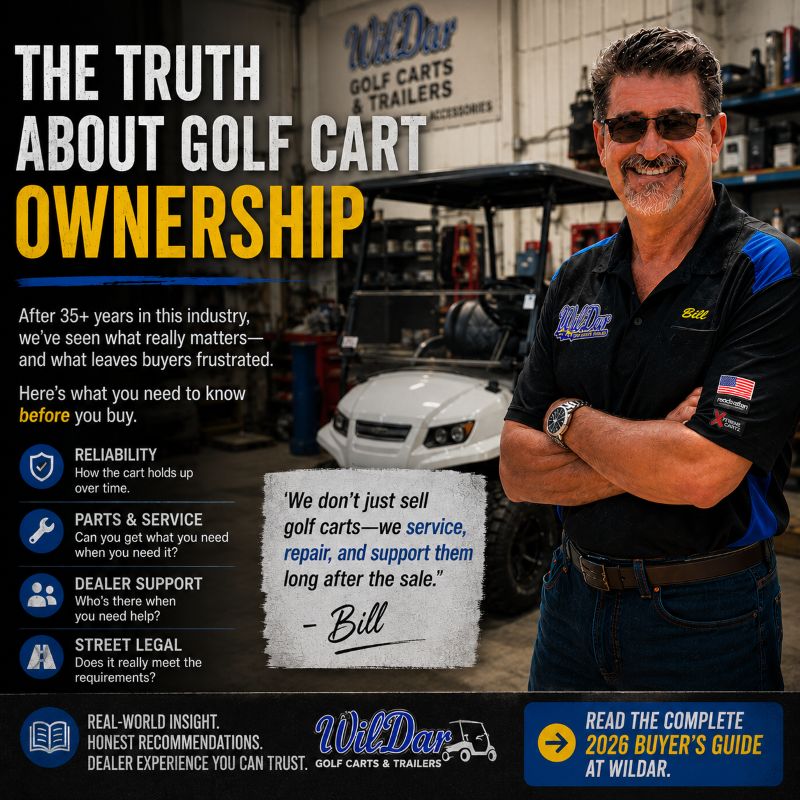
At WilDar Golf Carts & Trailers, when shoppers first walk in, many times the conversation begins with the asking me where they can drive and also what does street legal really mean?
Some ask about driving on sidewalks, or want to know how far they can drive on a charge.
Do I really need a tag? and can’t I just drive on the sidewalk?
In Florida, the answer depends on whether you are buying golf cart to ride only on private property or if you’d like to be able to make a quick run to the grocery store and to a restaurant just down the street
A regular golf cart is more limited and is usually restricted to golf courses, private property, approved golf cart communities, or specifically designated local roads. Read our street legal LSV FAQs to learn more
An LSV is built to be faster and safer than a golf cart. Tag, title, and insurance matter and cost less than most think.
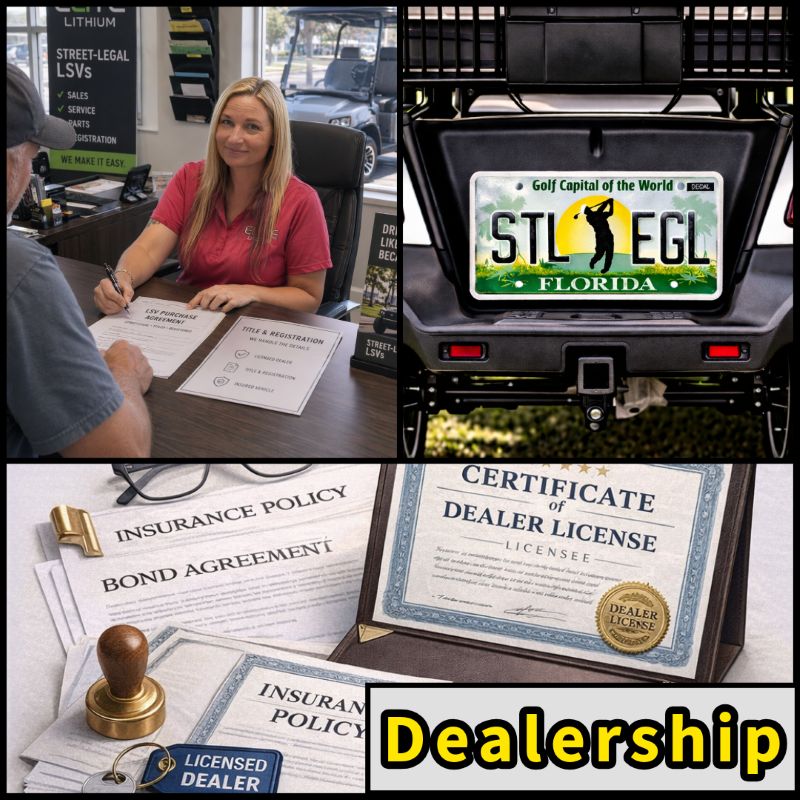
WilDar helps make that process easier with professional in-house tag and title service, so buyers do not have to guess their way through paperwork or leave unsure whether their vehicle is actually legal for road use.
This street legal lSV FAQs page answers the real questions Florida buyers ask before purchasing a street-legal golf cart or LSV: where you can drive, how fast you can go, what insurance is required, whether a cart can be converted, what makes an LSV legal, and why buying from an experienced local dealer matters.
Where can I legally drive a regular golf cart?
A regular golf cart is not the same as a street-legal LSV.
Golf carts are usually limited to private property, golf courses, approved communities, or roads specifically designated for golf cart use by local government.
Florida’s general rule is that golf carts are prohibited on public roads unless a specific statutory or local designation applies.
If you want to drive on public streets more broadly, you usually need a properly titled, tagged, insured LSV. Read on to learn more about our most commonly asked street legal LSV FAQs.
Can I drive a golf cart on the side walks?
Usually, no.
A regular golf cart cannot simply be driven on sidewalks just because it is small or because the road feels unsafe.
Florida law only allows golf carts on sidewalks when the local government has specifically approved golf cart use on designated sidewalk segments.
The local government must decide that golf carts, bicycles, and pedestrians can safely share that sidewalk, and the area must be properly posted or otherwise communicated to residents.
So the practical answer is: Do not assume sidewalks are legal for golf carts. Unless the sidewalk is part of a locally approved and posted golf cart route, treat it as off-limits.
For most regular golf cart owners, legal use is limited to private property, golf courses, approved communities, and roads or routes specifically designated for golf cart use by the city, county, or local authority. Read on to learn more about our most commonly asked street legal LSV FAQs.
Where can I drive a street legal LSV in Florida?
The practical answer is this: you can drive an LSV on approved neighborhood streets, community roads, and local roads posted 35 mph or less.
Justnot on highways, sidewalks, walking paths, or roads where the posted speed limit is too high. Read on to learn more about our most commonly asked street legal LSV FAQs.
What makes a golf cart street legal in Florida?
In Florida, a vehicle must meet federal low-speed vehicle (LSV) safety standards and be properly titled and registered to operate on public roads posted 35 mph or less.
Required equipment typically includes headlights, brake lights, turn signals, mirrors, seat belts, windshield, parking brake, and a federally compliant VIN. WilDar ensures every street-legal vehicle we sell is properly documented and ready for registration. See link below for more information.
What is the difference between a golf cart and a street-legal LSV?
A golf cart is generally a slow vehicle (under 20 mph) designed for golf courses, private property, approved communities, or specifically designated golf cart roads. It may have lights, turn signals, mirrors, or seat belts, but that does not automatically make it street legal. A golf cart has a serial number like a bicycle.
A street-legal Low-Speed Vehicle, is somewhere between a golf cart and a car. Designed to be faster and yet safer than a golf cart, a LSV is capable of speeds up to 25 mph, and has a VIN, and title. With insurance and a tag, street legal LSVs can connect our homes with convenient shopping, dining, and more on public roads that would be legally inaccessible on a golf cart. Read on to learn more about our most commonly asked street legal LSV FAQs.
How much does a license plate and insurance cost for street legal?
The first tag purchase includes a new plate, title fee and a couple other one-time tag office fees. But, after that the tag renewal is about what you might expect for a motorcylc.
Many buyers find LSV insurance to be reasonably affordable compared with a full-size car. A recent poll of average policy showed $388 average for the most recent policies including quoted coverages of :
- Liability (Bodily Injury): $100,000 / $300,000
- Property Damage: $100,000
- Uninsured Motorists: $100,000 / $300,000
- Personal Injury Protection: $10,000
- Towing & Emergency Expense: $75
- Includes Accessories: $1,000 limit Personal Effects: $1,000 limit
That sounds like a great deal the freedom of movement and peace of mind. Go where you want to go.
Keep in mind that insurance tag fees can vary. Read on to learn more about our most commonly asked street legal LSV FAQs.
Do I need a title and license plate for a street-legal golf cart in Florida?
Yes. A true street-legal LSV must be Titled, Registered, Plated, and iInsured (in most cases).
When you purchase from WilDar, we handle the full in-house tag and title process, so you avoid DMV confusion and leave ready to drive legally. Read on to learn more about our most commonly asked street legal LSV FAQs.
Can my existing golf cart be converted to a street-legal vehicle?
For the most part, yes. Florida has a pretty liberal golf cart to LSV conversion process. For older golf carts the challenge can be getting the golf cart to go faster than 20 mph. For many of the Chinese golf carts that people wnat to cnvert, the challenge is more likely to be identifying and obtaining parts like windshields for them. Check out links below for more information.
Are new imported carts automatically street legal?
No — and this is one of the biggest points of confusion.
Some imported vehicles are marketed as “street ready” and a fast talking saleperson can make it seem like it’s the same thing.
Proper street legality depends on Federal LSV compliance, correct VIN certification, and successful Florida titling.
WilDar focuses on authorized brands like EZGO, Atlas, and Tomberlin, plus professionally refurbished EZGO LSV conversions. With WilDar, you’ll always have a clear path to legal registration.
Can you drive a street-legal golf cart on public roads in Florida?
Yes — but only if the vehicle qualifies as a properly titled and registered Low-Speed Vehicle (LSV). Street-legal golf carts in Florida may operate on roads posted 35 mph or less when fully equipped and validly registered.
What roads can LSVs drive on in Port St. Lucie and Tradition?
In Florida, street-legal LSVs may operate on roads with speed limits of 35 mph or below and may cross higher-speed roads at designated intersections. Many neighborhoods in Port St. Lucie, Tradition, and Riverland are LSV-friendly, but route planning still matters.
Do street-legal golf carts require insurance in Florida?
Yes. Because a street-legal LSV is considered a motor vehicle in Florida, owners are typically required to carry minimum liability and Personal Injury Protection (PIP) insurance.
Do you need a driver’s license to drive an LSV in Florida?
Yes. Because a street-legal LSV is a titled motor vehicle, Florida law requires a valid driver’s license to operate it on public roads. This is a key difference between traditional golf carts and true LSVs.
How long does it take to title and tag an LSV?
When handled correctly by a licensed dealer like WilDar, many LSV purchases can receive a temporary tag immediately. Permanent plates typically arrive within a few days.
Still Have Questions?
Our team helps buyers across the Treasure Coast confidently choose the right street-legal vehicle.
- Compliance guidance
- In-house tag & title
- Authorized brands
- Local service support