
Federal Standards for Low-Speed Vehicles – FMVSS 500 and 49 CFR
What the law requires before a cart can be called an LSV
A low-speed vehicle is a federal class of motor vehicle, and the rules for it are written in Title 49 of the Code of Federal Regulations. Five of them do the work: the definition (571.3), the equipment standard (FMVSS 500), the pedestrian-sound standard (FMVSS 141), the VIN rule (Part 565) and the certification-label rule (Part 567). A sixth, Part 566, is the one that puts a manufacturer’s name on file with NHTSA.
NHTSA does not approve, inspect or certify vehicles. The manufacturer certifies its own vehicle, puts its name on the label, and carries the liability. That is why the name on the label matters more than anything a salesperson says, and why this page shows you how to check it.
The six regulations, in plain English
49 CFR 571.3 – Definition of a low-speed vehicle
Four wheels, not a truck, able to reach more than 20 mph but not more than 25 mph in one mile on a paved level surface, and a GVWR under 3,000 pounds. Slower than 20 mph is a golf cart and outside federal rules. Faster than 25 mph is a passenger car under federal law, whatever a state calls it.
49 CFR 571.500 – FMVSS No. 500, Low-speed vehicles
The FMVSS 500 equipment list. Headlamps, turn signals, tail and stop lamps, red reflectors, a driver-side exterior mirror plus one more mirror, a parking brake, an automotive-glass windshield (AS-1 or AS-5), a 17-character VIN, a seat belt at every seating position, and a rear visibility system. It also sets the 25 mph test. The standard says what the vehicle must have; it does not say who checks. The manufacturer does, by signing the label.
49 CFR 571.141 – FMVSS No. 141, Minimum sound for electric vehicles
Electric LSVs must make a pedestrian-alert sound at low speed and in reverse. This is the standard behind the 2026 Denago recall below.
49 CFR Part 565 – Vehicle Identification Number requirements
Every LSV must carry a 17-character VIN assigned by its manufacturer. The first three characters are the World Manufacturer Identifier (WMI), issued through SAE under contract to NHTSA, and they identify the company that certified the vehicle. The manufacturer must also file the key to its VINs with NHTSA so the number can be decoded. That filing is what NHTSA’s public decoder reads.
49 CFR Part 566 – Manufacturer identification
Anyone who manufactures motor vehicles for sale in the United States must register with NHTSA: legal name, address, and what they build. A company that converts golf carts to LSVs is a manufacturer under federal law and falls under this rule like any other.
49 CFR Part 567 – Certification
The label. It must be permanently attached and show the manufacturer’s name, the month and year of manufacture, the GVWR and axle ratings, the VIN, the vehicle type (“LOW-SPEED VEHICLE”), and the statement that the vehicle conforms to all applicable federal standards, FMVSS 500 included, on that date. The company named on that label is the one legally answerable for the vehicle. No label, or a label naming a company you cannot find, means no one has taken that responsibility.
Check the VIN against the label before you buy
The VIN and the certification label have to tell the same story. NHTSA’s position, restated in a 2024 interpretation letter, is that the WMI must identify the company that certifies the vehicle under Part 567. So the three names below should match.
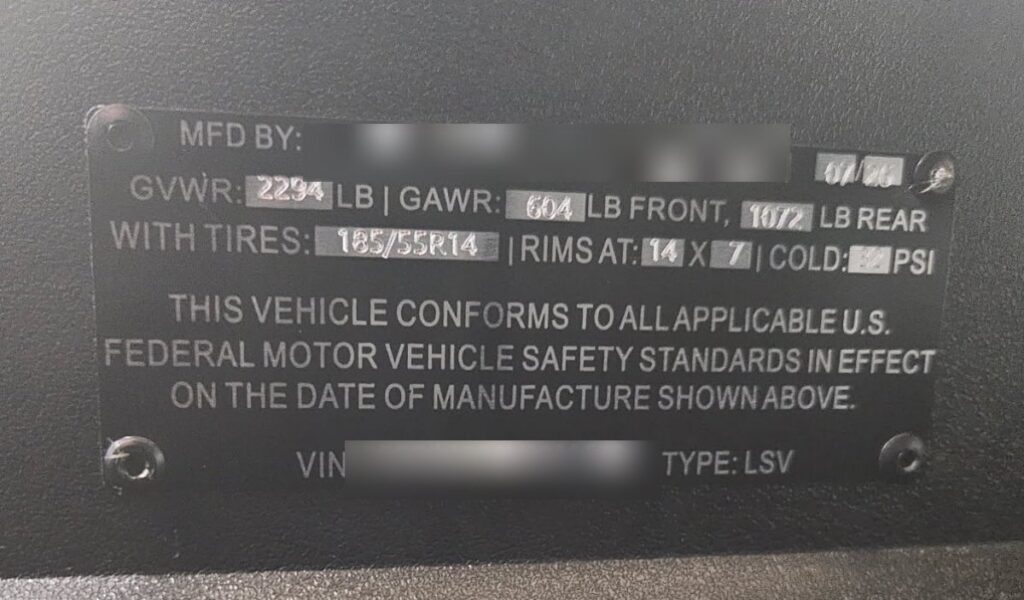
- Read the certification label. On most LSVs it is a metal or Mylar label on the driver’s side, below the dash (49 CFR 567.4 puts it on the hinge pillar, door-latch post or door edge next to the driver’s seat, otherwise the left side of the instrument panel). The VIN plate is a separate tag on the driver’s-side frame rail. Write down the manufacturer name, the date, and the vehicle-type line. It should say LOW-SPEED VEHICLE or LSV, not golf car or off-road.
- Run the VIN through NHTSA’s decoder. Enter all 17 characters. The result shows the manufacturer NHTSA has on file for that WMI, the vehicle type, and the model year. If the decoder cannot identify the manufacturer, NHTSA has no VIN filing for that maker. Ask the seller why before you go further.
- Compare three names: decoder, label, title. The manufacturer the decoder returns, the name on the certification label, and the make on the Florida title should be the same company. When they are not, you are looking at a vehicle whose paperwork and whose builder do not agree.
The Manufacturer Information Database is the second button. Search a company name and it shows whether that company is registered with NHTSA under Part 566, which WMIs it holds, and the documents it filed. If a brand on a cowl is not in that database, the brand did not certify the cart.
What a converted golf cart returns. A golf cart converted after it left the factory never received a manufacturer VIN. In Florida it is titled as ASPT, assembled from parts, under a state-assigned number. Run that number and NHTSA returns nothing, because no manufacturer certified it to FMVSS 500 or filed anything. That is not a glitch; it is the answer. The converter was legally the manufacturer and the certifier, and the federal record is empty.
What NHTSA has said about golf carts, conversions and LSVs
NHTSA’s Chief Counsel answers questions about FMVSS 500 and the rules around it in public interpretation letters. They are opinions on the facts presented, not regulations, and NHTSA says so in each one. They are also the clearest statement anywhere of how the agency reads its own rules. Five that matter for a Florida buyer:
- Kozloski letter, April 16, 2004 – A conventional golf cart (20 mph or less) is not a motor vehicle, so no federal standard applies to it. Modifying one for road use creates a new motor vehicle at the moment of modification. Whoever does the modifying is the manufacturer and must certify the vehicle to every applicable standard.
- Dynasty Electric Car letter, May 12, 2004 – NHTSA does not approve or certify any vehicle. Federal law is a self-certification system: the manufacturer certifies, and NHTSA enforces after the fact. Putting a speed governor on a full-speed car does not make it an LSV.
- Best Golf Cars letter, April 7, 2006 – Spells out which standards reach LSVs. At the time, FMVSS 500 and FMVSS 205 (glazing); FMVSS 141 has since been added for electric LSVs.
- Global Electric Motorcars letter, April 29, 2008 – A vehicle built to go faster than 25 mph is not an LSV, and a state law allowing it on the road does not change its federal class. Its manufacturer must certify it as a passenger car, with crash, brake and lighting standards to match. This is the letter to read before buying a “35 mph golf cart.”
- Ford Motor Company letter, September 11, 2024 – The WMI in a VIN must identify the manufacturer that certifies the vehicle under Part 567. An importer is not a manufacturer for this purpose and must use the VIN the original manufacturer assigned.
The standard itself was created by a final rule published June 17, 1998, which also stated that speed-modified golf cars capable of more than 20 mph are motor vehicles. Every letter NHTSA has issued is searchable at the NHTSA Interpretation File Search; try “low-speed vehicle” or “golf car.”
Recalls apply to LSVs, too
An FMVSS 500-certified LSV is in NHTSA’s recall system; a converted cart is not, because no manufacturer is on file to recall it. Enter any VIN at NHTSA’s recall lookup to see open campaigns.
Current example: in July 2026 Denago EV Corporation recalled about 34,136 Nomad, Rover and Scout LSVs because some may not produce the pedestrian-warning sound required by FMVSS 141. Owners can check their VIN with NHTSA or contact an authorized Denago dealer for the no-cost remedy. Read our full Denago LSV recall summary.
Where federal rules stop and Florida’s begin
Federal law decides what the vehicle must be when it is built. Florida decides whether it can be titled, registered, insured and driven, and on which roads. The state’s consumer page covers LSVs, golf carts and converted carts, the equipment Florida requires, insurance, title and registration, and the documents you need at the tax collector.
Not sure what you’re looking at?
- How to check a street legal golf cart before you buy – the three-step check with photos of the label.
- Already own a converted cart? What it is and what it isn’t
- Which LSV brands will still answer the phone in three years? Read the Buyers Guide
WilDar has been a franchise LSV dealer since 2014. Bring the VIN or a photo of the label and we will tell you what you have.
